
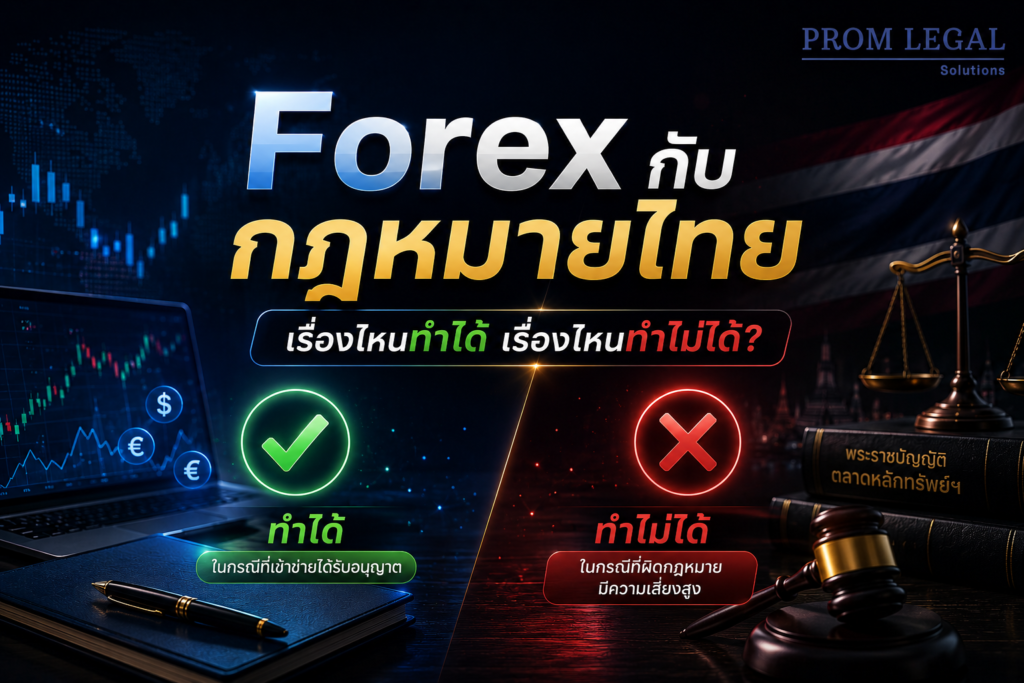
(English Below)
ทุกวันนี้คำว่า Forex หรือการเก็งกำไรจากอัตราแลกเปลี่ยนเงินตราต่างประเทศ ถูกพูดถึงกันมากในโลกออนไลน์ มีทั้งเพจชวนลงทุน คอร์สสอนเทรด และโบรกเกอร์ต่างประเทศจำนวนมาก คำถามที่หลายคนสงสัยคือ การเล่น Forex ผิดกฎหมายไทยหรือไม่ คำตอบไม่ได้เป็นขาวหรือดำทั้งหมด เพราะกฎหมายไทยแยกระหว่าง การทำธุรกรรมเงินตราต่างประเทศที่กฎหมายอนุญาต กับ การประกอบธุรกิจหรือการซื้อขายเงินตราต่างประเทศ (Forex) ที่ไม่ได้รับอนุญาต ไว้คนละส่วนกัน บทความนี้ทีมงาน Prom Legal Solution สรุปให้เข้าใจง่าย พร้อมอ้างอิงตัวบทกฎหมาย
กฎหมายหลักที่เกี่ยวข้อง
หัวใจของเรื่องนี้คือ พระราชบัญญัติควบคุมการแลกเปลี่ยนเงิน พ.ศ. 2485 และกฎกระทรวงที่ออกตามกฎหมายฉบับนี้ โดยเฉพาะกฎกระทรวง ฉบับที่ 13
พระราชบัญญัติควบคุมการแลกเปลี่ยนเงิน พ.ศ. 2485
| มาตรา 4 ของพระราชบัญญัติดังกล่าว ให้อำนาจรัฐมนตรีว่าการกระทรวงการคลังออกกฎกระทรวงเพื่อควบคุม จำกัด หรือห้ามการปฏิบัติกิจการทั้งปวงเกี่ยวกับการแลกเปลี่ยนเงิน หรือกิจการอื่นที่มีเงินตราต่างประเทศเข้ามาเกี่ยวข้อง ไม่ว่าจะเป็นการซื้อ การขาย การให้กู้ยืมเงินตราต่างประเทศ การส่งเงินออกนอกประเทศ การโอนหลักทรัพย์ และการกำหนดอัตราแลกเปลี่ยน |
กฎกระทรวง ฉบับที่ 13 ได้วางหลักสำคัญไว้สองข้อ คือ
| ข้อ 2 กำหนดว่า ห้ามมิให้บุคคลใด นอกจากธนาคารรับอนุญาต บริษัทรับอนุญาต หรือบุคคลรับอนุญาต ทำการซื้อ ขาย ให้กู้ยืม แลกเปลี่ยน หรือโอนปัจจัยชำระเงินต่างประเทศ เว้นแต่จะได้รับอนุญาตจากเจ้าพนักงาน
ข้อ 3 กำหนดว่า ห้ามมิให้บุคคลใดประกอบธุรกิจเกี่ยวกับปัจจัยชำระเงินต่างประเทศ เว้นแต่จะได้รับอนุญาตจากรัฐมนตรี โดยผู้ที่ประสงค์จะขออนุญาตต้องยื่นคำขอผ่านธนาคารแห่งประเทศไทย |
กล่าวง่าย ๆ คือ กิจกรรมเกี่ยวกับเงินตราต่างประเทศต้องทำผ่านผู้ที่ได้รับใบอนุญาตเท่านั้น ใครจะตั้งตัวเป็นผู้รับซื้อขายหรือรับแลกเปลี่ยนเงินตราต่างประเทศให้คนอื่นโดยไม่มีใบอนุญาต ถือว่าผิดกฎหมาย
ใครคือผู้ที่ได้รับอนุญาตตามกฎหมาย?
กฎกระทรวง ฉบับที่ 13 ได้นิยามผู้ที่ทำธุรกิจเงินตราต่างประเทศได้อย่างถูกกฎหมายไว้ ดังนี้
- ธนาคารรับอนุญาต คือ ธนาคารพาณิชย์ที่ได้รับอนุญาตให้ประกอบธุรกิจเกี่ยวกับปัจจัยชำระเงินต่างประเทศ (เช่น เงินตราต่างประเทศหรือเครื่องมือการชำระเงินที่กฎหมายกำหนด)
- บริษัทรับอนุญาต คือ บริษัทจำกัดที่ได้รับอนุญาตให้ประกอบธุรกิจเกี่ยวกับปัจจัยชำระเงินต่างประเทศ ซึ่งมิใช่ธนาคาร
- บุคคลรับอนุญาต คือ บุคคลที่ได้รับอนุญาตให้ซื้อ ขาย ให้กู้ยืม แลกเปลี่ยนธนบัตรต่างประเทศ เหรียญกษาปณ์ต่างประเทศ หรือเช็คสำหรับเดินทางที่พึงจ่ายเป็นเงินตราต่างประเทศ ซึ่งก็คือร้านรับแลกเงินที่มีใบอนุญาตนั่นเอง
ต่อมายังมีการเพิ่มนิยาม นิติบุคคลรับอนุญาต เพื่อรวมถึงนิติบุคคลที่มีกฎหมายเฉพาะจัดตั้งขึ้นและได้รับอนุญาตให้ประกอบธุรกิจเกี่ยวกับปัจจัยชำระเงินต่างประเทศด้วย
เรื่องที่ทำได้ตามกฎหมาย
สำหรับประชาชนและนักลงทุนทั่วไป กิจกรรมเหล่านี้สามารถทำได้ หากดำเนินการผ่านช่องทางที่ถูกต้อง ทั้งนี้ หมายถึงการทำธุรกรรมเงินตราต่างประเทศที่กฎหมายอนุญาต ไม่รวมถึงการซื้อขาย Forex หรือ CFD ผ่านแพลตฟอร์มต่างประเทศที่ไม่ได้รับอนุญาต อย่างไรก็ดี คำว่า “ทำได้” ในที่นี้ไม่ได้หมายความว่าบุคคลทั่วไปสามารถเทรด Forex เพื่อเก็งกำไรผ่านแพลตฟอร์มต่างประเทศได้โดยเสรี
- แลกเปลี่ยนเงินตราต่างประเทศกับธนาคารรับอนุญาต บริษัทรับอนุญาต หรือร้านรับแลกเงินที่เป็นบุคคลรับอนุญาต เช่น แลกเงินก่อนเดินทางไปต่างประเทศ
- โอนเงินและส่งเงินออกนอกประเทศเพื่อวัตถุประสงค์ที่กฎหมายและธนาคารแห่งประเทศไทยกำหนด เช่น การส่งเงินไปเลี้ยงดูครอบครัวและญาติพี่น้องในต่างประเทศ โดยทำผ่านธนาคารรับอนุญาตหรือบริษัทรับอนุญาต
- ลงทุนในหลักทรัพย์หรือสินทรัพย์ต่างประเทศผ่านผู้ประกอบธุรกิจที่ได้รับใบอนุญาตอย่างถูกต้อง เช่น บริษัทหลักทรัพย์ที่อยู่ภายใต้การกำกับของสำนักงานคณะกรรมการกำกับหลักทรัพย์และตลาดหลักทรัพย์ หรือการลงทุนผ่านกองทุนรวมที่ไปลงทุนในต่างประเทศ ซึ่งดำเนินการตามหลักเกณฑ์ของหน่วยงานกำกับดูแล ทั้งนี้ การลงทุนในลักษณะดังกล่าวมิใช่การซื้อขาย Forex หรือ CFD ผ่านแพลตฟอร์มที่ไม่ได้รับอนุญาต
หลักการสำคัญคือ ตราบใดที่ทำธุรกรรมผ่านผู้ที่ได้รับใบอนุญาตและปฏิบัติตามหลักเกณฑ์ของธนาคารแห่งประเทศไทย ก็สามารถทำได้โดยชอบด้วยกฎหมาย
เรื่องที่ทำไม่ได้ตามกฎหมาย
ในทางกลับกัน การกระทำต่อไปนี้สุ่มเสี่ยงผิดกฎหมายอย่างชัดเจน
- ประกอบธุรกิจรับซื้อขายแลกเปลี่ยนเงินตราต่างประเทศ หรือประกอบธุรกิจเกี่ยวกับปัจจัยชำระเงินต่างประเทศในลักษณะโบรกเกอร์ Forex โดยรับเงินจากประชาชนเพื่อนำไปซื้อขายหรือเก็งกำไรค่าเงิน ทั้งที่ไม่ได้รับอนุญาตจากรัฐมนตรีว่าการกระทรวงการคลัง ถือว่าฝ่าฝืนพระราชบัญญัติควบคุมการแลกเปลี่ยนเงิน พุทธศักราช 2485 และกฎกระทรวง ฉบับที่ 13
- ตั้งตัวเป็นตัวแทนรวบรวมเงินจากบุคคลหลายคนเพื่อนำไปเก็งกำไรอัตราแลกเปลี่ยน โดยไม่มีใบอนุญาต
- อ้างว่าเป็นคอมมิชชั่นเฮ้าส์หรือโบรกเกอร์ที่จดทะเบียนถูกต้อง ทั้งที่ไม่ได้รับอนุญาตจริง เพื่อชักชวนให้คนนำเงินมาร่วมลงทุน การปกปิดหรือบิดเบือนข้อเท็จจริงเช่นนี้ นอกจากผิดกฎหมายควบคุมการแลกเปลี่ยนเงินแล้ว ยังอาจเข้าข่ายความผิดฐานฉ้อโกง และหากเป็นการหลอกลวงประชาชน อาจเป็นความผิดฐานฉ้อโกงประชาชนตามประมวลกฎหมายอาญา มาตรา 343 ได้อีกด้วย หากมีองค์ประกอบความผิดครบถ้วนตามกฎหมาย
- การนำเงินตราหรือเงินตราต่างประเทศและตราสารเปลี่ยนมือออกไปนอกหรือเข้ามาในประเทศโดยฝ่าฝืนหลักเกณฑ์ ปัจจุบันมีมาตรการควบคุมเพิ่มเติมตามมาตรา 6/1 และมาตรา 8 ทวิ ของพระราชบัญญัติควบคุมการแลกเปลี่ยนเงิน ซึ่งเพิ่มเติมเพื่อรองรับพันธกรณีด้านการป้องกันและปราบปรามการฟอกเงินและการต่อต้านการสนับสนุนทางการเงินแก่การก่อการร้าย ทั้งนี้ มาตรา 8 ทวิ เป็นมาตรการควบคุมการนำเงินตราและตราสารเปลี่ยนมือเข้า-ออกราชอาณาจักร มิใช่บทกำหนดโทษของการประกอบธุรกิจโดยไม่ได้รับอนุญาต ซึ่งบทกำหนดโทษของการฝ่าฝืนกฎกระทรวงคือมาตรา 8 (ดูหัวข้อโทษตามกฎหมาย)
ข้อสังเกตสำคัญสำหรับประชาชน คือ แม้ตัวผู้ลงทุนที่นำเงินไปร่วมเทรดด้วยความสมัครใจอาจไม่ได้เป็นผู้กระทำความผิดเสมอไป ทั้งนี้ต้องพิจารณาข้อเท็จจริงเป็นรายกรณี แต่เงินที่ลงไปกับผู้ให้บริการที่ไม่มีใบอนุญาตมีความเสี่ยงสูงมากที่จะสูญ และเมื่อเกิดปัญหาขึ้น การติดตามเงินคืนทำได้ยาก เพราะผู้ให้บริการอยู่นอกระบบที่กฎหมายคุ้มครอง
ทั้งนี้ ธนาคารแห่งประเทศไทยเคยออกประกาศเตือนประชาชนว่า ปัจจุบันยังไม่เคยอนุญาตให้บุคคลทั่วไปซื้อขายเงินตราต่างประเทศเพื่อการลงทุนหรือเก็งกำไรผ่านแพลตฟอร์มหรือเว็บไซต์ Forex และการให้บริการรับ–ส่งเงินเพื่อธุรกรรมดังกล่าวอาจเป็นการฝ่าฝืนกฎหมายว่าด้วยการควบคุมการแลกเปลี่ยนเงิน
โทษตามกฎหมาย
การประกอบธุรกิจเกี่ยวกับปัจจัยชำระเงินต่างประเทศโดยไม่ได้รับอนุญาต เป็นความผิดตามมาตรา 8 แห่งพระราชบัญญัติควบคุมการแลกเปลี่ยนเงิน พุทธศักราช 2485 ซึ่งบัญญัติว่า ผู้ใดฝ่าฝืนหรือละเลยไม่ปฏิบัติตามกฎกระทรวง ประกาศ หรือคำสั่งที่ออกตามความในพระราชบัญญัตินี้ ต้องระวางโทษปรับไม่เกิน 20,000 บาท หรือจำคุกไม่เกิน 3 ปี หรือทั้งจำทั้งปรับ นอกจากนี้ หากมีพฤติการณ์หลอกลวงประชาชน ยังอาจมีความผิดฐานฉ้อโกงประชาชนตามประมวลกฎหมายอาญา มาตรา 343 ซึ่งมีโทษหนักขึ้น
สรุป
หลักง่าย ๆ ที่ควรจำคือ การทำธุรกรรมเงินตราต่างประเทศ หรือการลงทุนต่างประเทศที่กฎหมายอนุญาต ต้องทำผ่านผู้ที่ได้รับใบอนุญาตหรือช่องทางที่หน่วยงานกำกับดูแลกำหนด ไม่ว่าจะเป็นธนาคารรับอนุญาต บริษัทรับอนุญาต ร้านรับแลกเงินที่มีใบอนุญาต หรือบริษัทหลักทรัพย์และกองทุนที่อยู่ภายใต้การกำกับของหน่วยงานรัฐ ส่วนการเปิดรับซื้อขายหรือรับแลกเปลี่ยนเงินตราต่างประเทศให้คนอื่นเป็นธุรกิจโดยไม่มีใบอนุญาต รวมถึงการชักชวนคนมาร่วมเก็งกำไรค่าเงินผ่านช่องทางนอกระบบ เป็นเรื่องที่ทำไม่ได้และมีความเสี่ยงทั้งทางกฎหมายและทางการเงิน
ก่อนตัดสินใจลงทุนกับแพลตฟอร์มหรือบุคคลใด ควรตรวจสอบใบอนุญาตและสถานะทางกฎหมายให้ชัดเจน หากไม่แน่ใจ การปรึกษาผู้เชี่ยวชาญด้านกฎหมายก่อนจะช่วยลดความเสี่ยงได้มาก
ปรึกษาเรา Prom Legal Solution พร้อมให้คำปรึกษาด้านกฎหมายการเงิน การลงทุน และการตรวจสอบความถูกต้องตามกฎหมายของการประกอบธุรกิจที่เกี่ยวข้องกับเงินตราต่างประเทศ หากท่านมีข้อสงสัยเกี่ยวกับ Forex หรือการลงทุนในต่างประเทศ สามารถทักมาสอบถามทีมงานของเราได้
หมายเหตุ: บทความนี้จัดทำขึ้นเพื่อให้ความรู้ทางกฎหมายแก่ประชาชนทั่วไป มิใช่ความเห็นทางกฎหมายเฉพาะกรณี การปรับใช้กับข้อเท็จจริงของแต่ละท่านควรปรึกษาทนายความเป็นรายกรณี
#Forex #กฎหมายForex #การลงทุน #กฎหมายการเงิน #โบรกเกอร์ #เตือนภัยการลงทุน #กฎหมายธุรกิจ #PromLegalSolution #LegalTip
Forex and Thai Law: What’s Allowed and What’s Not?
These days, the word “Forex” — speculating on foreign exchange rate movements — is everywhere online. There are pages inviting people to invest, courses teaching trading, and a large number of foreign brokers. The question many people have is whether playing Forex is illegal under Thai law. The answer is not entirely black or white, because Thai law draws a distinction between foreign-currency transactions that the law permits and carrying on a business or trading foreign currency (Forex) without a licence — treating them as two separate matters. In this article, the Prom Legal Solution team breaks it down in plain language, with references to the actual legal provisions.
The Key Laws Involved
At the heart of this issue is the Exchange Control Act, B.E. 2485 (1942) and the ministerial regulations issued under it — in particular Ministerial Regulation No. 13.
Exchange Control Act, B.E. 2485 (1942)
Section 4 of the Act empowers the Minister of Finance to issue ministerial regulations to control, restrict, or prohibit all activities relating to the exchange of money, or other activities involving foreign currency — whether the buying, selling, or lending of foreign currency, sending money out of the country, transferring securities, or setting exchange rates.
Ministerial Regulation No. 13 lays down two key principles:
Clause 2 provides that no person — other than an authorised bank, an authorised company, or an authorised person — may buy, sell, lend, exchange, or transfer foreign means of payment, unless permitted by the competent officer.
Clause 3 provides that no person may carry on a business relating to foreign means of payment unless permitted by the Minister, and anyone wishing to apply for permission must submit the application through the Bank of Thailand.
Put simply: activities involving foreign currency must be conducted only through a licensed party. Anyone who sets themselves up to buy, sell, or exchange foreign currency for others without a licence is acting illegally.
Who Is Authorised Under the Law?
Ministerial Regulation No. 13 defines those who may lawfully conduct foreign-currency business as follows:
Authorised bank — a commercial bank licensed to carry on a business relating to foreign means of payment (such as foreign currency or payment instruments prescribed by law).
Authorised company — a limited company, other than a bank, licensed to carry on a business relating to foreign means of payment.
Authorised person — a person licensed to buy, sell, lend, or exchange foreign banknotes, foreign coins, or travellers’ cheques payable in foreign currency — in other words, a licensed money-changing shop.
Later, the definition of authorised juristic person was added to cover juristic persons established under specific legislation and licensed to carry on a business relating to foreign means of payment.
What Is Allowed Under the Law
For the general public and ordinary investors, the following activities are permitted, provided they are carried out through proper channels. This means foreign-currency transactions that the law permits — it does not include trading Forex or CFDs through unlicensed foreign platforms. That said, “allowed” here does not mean ordinary individuals are free to trade Forex for speculation through foreign platforms.
- Exchanging foreign currency with an authorised bank, an authorised company, or a licensed money-changing shop (an authorised person) — for example, exchanging money before travelling abroad.
- Transferring and sending money out of the country for purposes prescribed by law and by the Bank of Thailand — for example, sending money to support family and relatives abroad — done through an authorised bank or authorised company.
- Investing in foreign securities or assets through properly licensed business operators — for example, securities companies supervised by the Securities and Exchange Commission, or investing through mutual funds that invest abroad in accordance with the rules of the regulatory authorities. Investments of this kind are not the trading of Forex or CFDs through unlicensed platforms.
The key principle is that as long as a transaction is conducted through a licensed party and complies with the rules of the Bank of Thailand, it can be done lawfully.
What Is Not Allowed Under the Law
Conversely, the following conduct clearly risks being illegal:
- Carrying on a business of buying, selling, or exchanging foreign currency — or carrying on a business relating to foreign means of payment in the manner of a Forex broker — by taking money from the public to trade or speculate on currency, without permission from the Minister of Finance. This violates the Exchange Control Act, B.E. 2485 (1942) and Ministerial Regulation No. 13.
- Setting oneself up as an agent to pool money from a number of people in order to speculate on exchange rates, without a licence.
- Claiming to be a properly registered commission house or broker when not actually licensed, in order to persuade people to bring money to invest. Concealing or distorting the facts in this way is not only a breach of the exchange control law but may also amount to the offence of fraud — and, where it involves deceiving the public, may constitute the offence of public fraud under Section 343 of the Criminal Code, if all the elements of the offence are present.
- Bringing currency or foreign currency and negotiable instruments out of or into the country in breach of the rules. There are now additional control measures under Section 6/1 and Section 8 bis of the Exchange Control Act, added to support obligations relating to anti-money laundering and countering the financing of terrorism. Note that Section 8 bis is a measure controlling the movement of currency and negotiable instruments into and out of the Kingdom — it is not the penalty provision for carrying on a business without a licence. The penalty for breaching the ministerial regulation is Section 8 (see the section on penalties below).
An important point for the public: even though an investor who voluntarily puts money in to trade may not always be the wrongdoer — this must be assessed on a case-by-case basis — money placed with an unlicensed service provider carries a very high risk of being lost, and when problems arise, recovering the money is difficult because the provider operates outside the system that the law protects.
In this regard, the Bank of Thailand has issued a public warning that it has, to date, never permitted ordinary individuals to trade foreign currency for investment or speculation through Forex platforms or websites, and that providing money-transfer services for such transactions may breach the law on exchange control.
Penalties Under the Law
Carrying on a business relating to foreign means of payment without a licence is an offence under Section 8 of the Exchange Control Act, B.E. 2485 (1942), which provides that anyone who violates or fails to comply with the ministerial regulations, notifications, or orders issued under the Act is liable to a fine not exceeding 20,000 baht, or imprisonment not exceeding 3 years, or both. In addition, where there is conduct that deceives the public, there may also be the offence of public fraud under Section 343 of the Criminal Code, which carries a heavier penalty.
Conclusion
The simple rule to remember is this: foreign-currency transactions, or foreign investments that the law permits, must be carried out through a licensed party or through the channels prescribed by the regulatory authorities — whether an authorised bank, an authorised company, a licensed money-changing shop, or securities companies and funds supervised by state agencies. By contrast, opening up to buy, sell, or exchange foreign currency for others as a business without a licence, including inviting people to join in speculating on currency through channels outside the system, is something that cannot be done and carries both legal and financial risk.
Before deciding to invest with any platform or person, you should clearly verify their licence and legal status. If you are unsure, consulting a legal expert beforehand can substantially reduce the risk.
Consult us. Prom Legal Solution is ready to provide legal advice on finance, investment, and verifying the legal compliance of businesses involving foreign currency. If you have questions about Forex or investing abroad, feel free to message our team.
Note: This article is prepared to provide general legal knowledge to the public; it is not legal advice for any specific case. Applying it to your own facts should be done by consulting a lawyer on a case-by-case basis.
#Forex #ForexLaw #Investment #FinancialLaw #Broker #InvestmentScamAlert #BusinessLaw #PromLegalSolution #LegalTip