
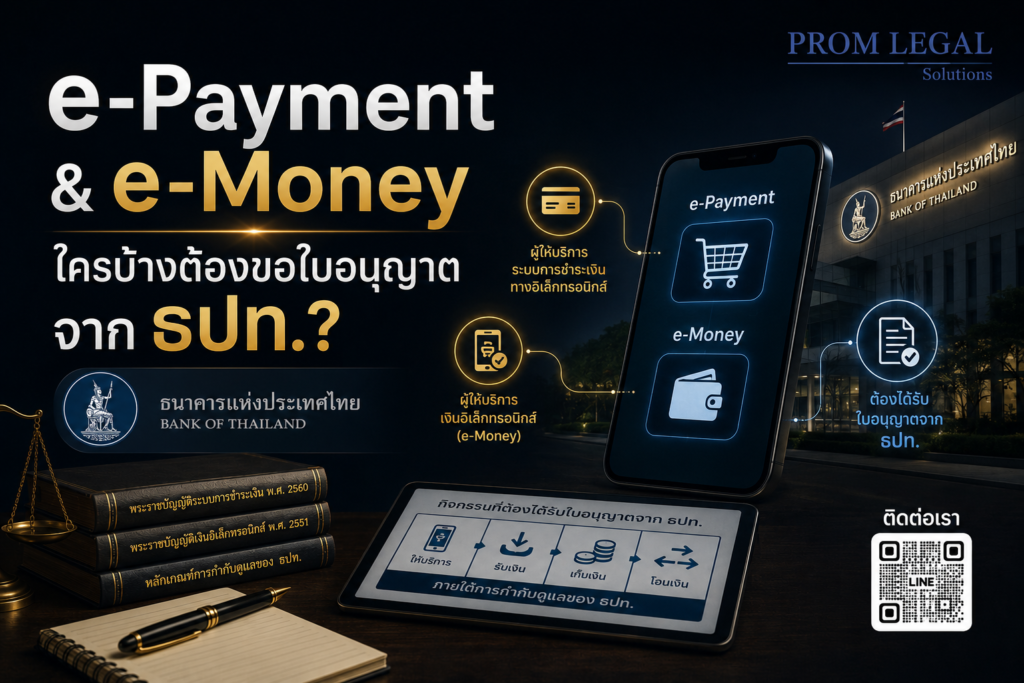
(English Below)
คำถามนี้กำลังเป็นเรื่องใหญ่สำหรับสตาร์ทอัพ ร้านค้าออนไลน์ และแพลตฟอร์มที่คิดจะออก กระเป๋าเงินอิเล็กทรอนิกส์หรือรับชำระเงินแทนคนอื่น เพราะทำผิดขั้นตอนเพียงเล็กน้อย โทษไม่ใช่แค่ปรับ แต่ถึงขั้นจำคุก
วันนี้ Prom Legal Solution สรุปให้เข้าใจง่าย ๆ ว่ากฎหมายวางกรอบไว้อย่างไร และใครบ้างที่ต้องเข้าระบบของธนาคารแห่งประเทศไทย (ธปท.)
กฎหมายหลักที่ใช้บังคับ
ปัจจุบันการกำกับดูแลรวมอยู่ในฉบับเดียว คือ พระราชบัญญัติระบบการชำระเงิน พ.ศ. 2560 โดยมี ธปท. เป็นผู้กำกับดูแล กฎหมายแบ่งสิ่งที่ต้องกำกับออกเป็น 2 กลุ่ม
- ระบบการชำระเงินภายใต้การกำกับ (มาตรา 12–13) เช่น ระบบโอนเงินรายย่อยระหว่างผู้ใช้บริการ ระบบเครือข่ายบัตร ระบบการหักบัญชีและชำระดุล ซึ่งเป็น “โครงสร้างพื้นฐาน” ของการชำระเงิน
- บริการการชำระเงินภายใต้การกำกับ (มาตรา 16) คือบริการที่ให้แก่ผู้ใช้โดยตรง ได้แก่
- การให้บริการบัตรเครดิต บัตรเดบิต หรือบัตรเอทีเอ็ม
- การให้บริการเงินอิเล็กทรอนิกส์ (e-Money)
- การรับชำระเงินด้วยวิธีทางอิเล็กทรอนิกส์แทนผู้ขายสินค้า ผู้ให้บริการ หรือเจ้าหนี้ (payment collection)
- การโอนเงินด้วยวิธีทางอิเล็กทรอนิกส์ (e-Fund transfer)
- การให้บริการชำระเงินอื่นใดที่อาจกระทบต่อระบบการเงินหรือประโยชน์สาธารณะ
หากธุรกิจของคุณเข้าข่ายข้อใดข้อหนึ่งข้างต้น โดยหลักแล้ว ต้องเข้าสู่ระบบของ ธปท. ก่อนเริ่มให้บริการ
แต่ขออนุญาตกับขึ้นทะเบียนไม่เหมือนกัน
กฎหมายได้แบ่งระดับการเข้าสู่ระบบเป็น 2 แบบ ตามความเสี่ยงและผลกระทบ โดย
- การขออนุญาต (License) จะใช้สำหรับบริการหลักที่มีผลกระทบเป็นวงกว้าง
- การขึ้นทะเบียน (Register) จะใช้สำหรับบริการที่เป็นนวัตกรรมซึ่งอยู่ระหว่างทดสอบ หรือให้บริการลูกค้าในวงจำกัดโดยไม่กระทบระบบการชำระเงินในวงกว้าง
นอกจากนี้ ผู้ประกอบธุรกิจต้องเป็นนิติบุคคลประเภทบริษัทจำกัดหรือบริษัทมหาชนจำกัด หรือรูปแบบอื่นตามที่ ธปท. กำหนดเท่านั้น จึงจะขออนุญาตหรือขึ้นทะเบียนได้ (มาตรา 13)
แล้วใครที่ไม่ต้องขอ?
e-Money บางลักษณะได้รับการผ่อนปรน เช่น บัตรหรือกระเป๋าเงินที่ใช้ซื้อสินค้าหรือรับบริการเฉพาะอย่างจากผู้ให้บริการเพียงรายเดียว เนื่องจากเป็นระบบปิด เช่น บัตรเติมเงินใช้ในร้านตัวเองเท่านั้น หรือการให้บริการที่ใช้จำกัดเพื่ออำนวยความสะดวกแก่ผู้บริโภคโดยไม่ได้แสวงหากำไรจากการออกบัตร
ทั้งนี้ทั้งนั้น ผู้ประกอบธุรกิจจะต้องแจ้งให้ทราบ จะต้องขึ้นทะเบียน หรือจะต้องขออนุญาตหรือไม่นั้น เป็นไปตามประกาศของกระทรวงการคลังและ ธปท. จึงควรตรวจสอบลักษณะบริการเป็นรายกรณีก่อนเสมอ
ระวัง ถ้าทำโดยไม่เข้าระบบ = เสี่ยงโทษอาญา
พ.ร.บ.ระบบการชำระเงิน พ.ศ. 2560 กำหนดโทษไว้ชัดเจนว่า
- หากประกอบธุรกิจโดยไม่ได้ขึ้นทะเบียน จะต้องระวางโทษจำคุกไม่เกิน 5 ปี หรือปรับไม่เกิน 500,000 บาท หรือทั้งจำทั้งปรับ (มาตรา 44, มาตรา 45)
- หากประกอบธุรกิจโดยไม่ได้รับอนุญาต จะต้องระวางโทษจำคุกตั้งแต่ 2 ถึง 10 ปี หรือปรับตั้งแต่ 200,000 ถึง 1,000,000 บาท หรือทั้งจำทั้งปรับ (มาตรา 44, มาตรา 45)
โดยสรุปแล้วถ้าธุรกิจของคุณออก e-Money รับชำระเงินแทนคนอื่น หรือโอนเงินทางอิเล็กทรอนิกส์ให้ผู้ใช้ทั่วไป มีโอกาสสูงมากที่ต้องขออนุญาตหรือขึ้นทะเบียนกับ ธปท. ก่อนเปิดให้บริการ อย่ารอให้ถูกร้องเรียนหรือตรวจสอบก่อนแล้วค่อยแก้ เพราะมีโทษถึงขั้นจำคุก
Prom Legal Solution พร้อมให้คำปรึกษาด้านการขอใบอนุญาตและขึ้นทะเบียนธุรกิจ e-Payment และ e-Money ตั้งแต่การประเมินว่าธุรกิจของคุณเข้าข่ายหรือไม่ ไปจนถึงการจัดเตรียมเอกสารยื่นต่อ ธปท.
#PromLegalSolution #ePayment #eMoney #ธปท #กฎหมายธุรกิจ #FinTech #ใบอนุญาต #ที่ปรึกษากฎหมาย
e-Payment & e-Money: Who Needs a License from the Bank of Thailand (BOT)?
This question has become a major issue for startups, online merchants, and platforms considering issuing an electronic wallet or collecting payments on behalf of others—because even a small procedural misstep can carry penalties that go beyond fines to imprisonment.
Today, Prom Legal Solution breaks down, in simple terms, how the law sets the framework and who must enter the Bank of Thailand (BOT) regulatory system.
The Principal Governing Law
At present, regulation is consolidated into a single statute: the Payment Systems Act B.E. 2560 (2017), with the BOT as the regulator. The law divides what must be regulated into two categories:
- Payment systems under supervision (Sections 12–13)—for example, interbank retail funds transfer systems between users, card network systems, and clearing and settlement systems, which form the “infrastructure” of payments.
- Payment services under supervision (Section 16)—services provided directly to users, namely:
- Providing credit card, debit card, or ATM card services
- Providing electronic money (e-Money) services
- Collecting payments by electronic means on behalf of sellers, service providers, or creditors (payment collection)
- Transferring funds by electronic means (e-Fund transfer)
- Providing any other payment service that may affect the financial system or the public interest
If your business falls under any of the above, then as a general rule, you must enter the BOT system before commencing operations.
But Applying for a License Is Not the Same as Registering
The law divides entry into the system into two tiers, based on risk and impact:
- Licensing (License) applies to core services with broad-scale impact.
- Registration (Register) applies to innovative services that are in a testing phase, or that serve a limited group of customers without affecting the payment system on a broad scale.
In addition, a business operator must be a juristic person in the form of a limited company or a public limited company, or another form as prescribed by the BOT, in order to apply for a license or register (Section 13).
So Who Is Exempt?
Certain forms of e-Money receive relief—for example, a card or wallet used to purchase specific goods or services from a single provider only, since this is a closed-loop system (such as a prepaid card usable only in the issuer’s own store), or services provided on a limited basis to facilitate consumer convenience without seeking profit from issuing the card.
That said, whether a business operator must merely notify, must register, or must obtain a license depends on the notifications issued by the Ministry of Finance and the BOT. You should therefore always review the nature of your service on a case-by-case basis first.
Caution: Operating Without Entering the System = Risk of Criminal Penalties
The Payment Systems Act B.E. 2560 (2017) sets out clear penalties:
- Operating a business without registering carries a penalty of imprisonment of up to 5 years, or a fine of up to THB 500,000, or both (Sections 44, 45).
- Operating a business without a license carries a penalty of imprisonment from 2 to 10 years, or a fine from THB 200,000 to 1,000,000, or both (Sections 44, 45).
In summary, if your business issues e-Money, collects payments on behalf of others, or transfers funds electronically for the general public, there is a very high likelihood that you must obtain a license from, or register with, the BOT before launching. Don’t wait until you’re the subject of a complaint or investigation before fixing it—the penalties extend to imprisonment.
Prom Legal Solution is ready to advise on licensing and registration for e-Payment and e-Money businesses, from assessing whether your business is covered, all the way to preparing the documents for submission to the BOT.
#PromLegalSolution #ePayment #eMoney #BOT #BusinessLaw #FinTech #License #LegalConsultant