(English Below)
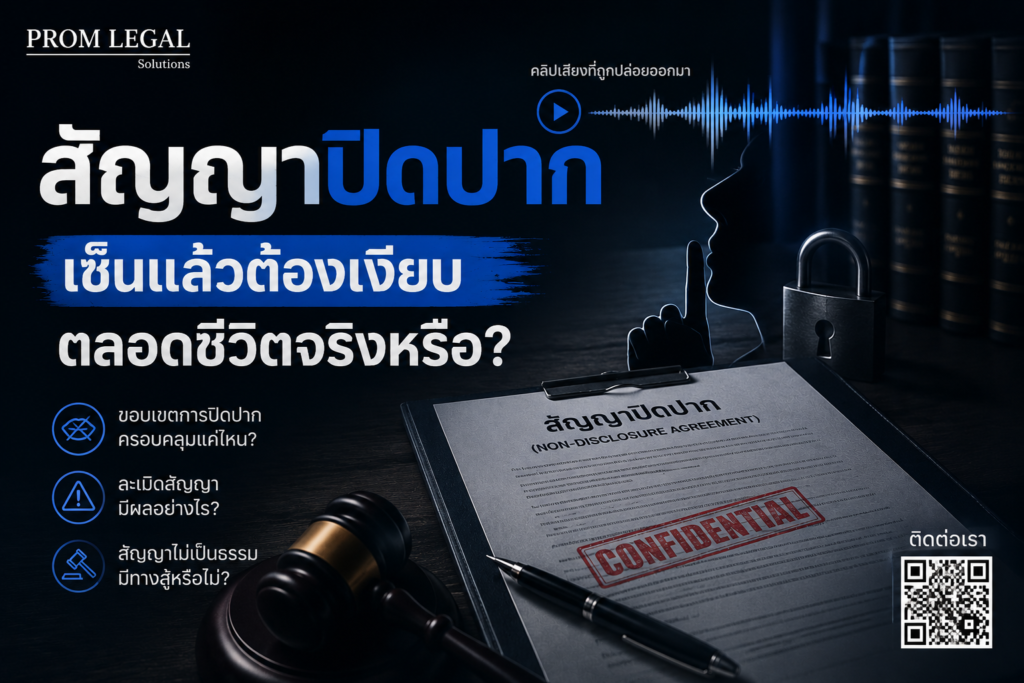
จากกรณีข่าวที่สังคมกำลังให้ความสนใจเกี่ยวกับ “สัญญาปิดปาก” (กรณีที่กำลังเป็นข่าว) คำถามที่หลายคนสงสัยตรงกันคือ เอกสารที่ห้ามเราพูด ห้ามเปิดเผยข้อมูล หรือกำหนดค่าปรับมหาศาลแบบนี้ มัน บังคับได้จริงตามกฎหมายแค่ไหน?
Prom Legal Solution ขอชวนทุกคนทำความเข้าใจหลักกฎหมายที่อยู่เบื้องหลังเรื่องนี้ โดยไม่ก้าวล่วงข้อเท็จจริงของคู่กรณีรายใด เพราะเชื่อว่าความเข้าใจที่ถูกต้องคือเกราะป้องกันที่ดีที่สุดของทุกคน
สัญญาปิดปากคืออะไร?
ในทางปฏิบัติ สัญญาปิดปากมักเป็นชื่อเรียกกันเองของ ข้อตกลงรักษาความลับหรือห้ามเปิดเผยข้อมูล (Non-Disclosure Agreement หรือ NDA) หรือข้อตกลงห้ามพูดถึงอีกฝ่ายในทางเสียหาย (Non-Disparagement) ซึ่งอาจอยู่ในรูปสัญญาเดี่ยว ๆ หรือเป็นข้อหนึ่งในสัญญาประนีประนอม สัญญาจ้างงาน หรือสัญญายุติข้อพิพาทก็ได้ จุดร่วมคือ ฝ่ายหนึ่งตกลงจะไม่พูด ไม่เปิดเผย และถ้าฝ่าฝืนจะมีบทลงโทษ
แม้ทั้งสองประเภทมักถูกเรียกรวมว่า “สัญญาปิดปาก” แต่ในทางกฎหมายมีวัตถุประสงค์ต่างกัน โดย NDA มุ่งคุ้มครองข้อมูลลับ ขณะที่ Non-Disparagement มุ่งป้องกันการกล่าวถึงอีกฝ่ายในลักษณะที่อาจกระทบชื่อเสียง
การกำหนดระยะเวลารักษาความลับเป็นเวลานานหรือไม่มีกำหนดอาจทำได้ในบางกรณี โดยเฉพาะข้อมูลลับทางการค้าหรือความลับทางธุรกิจ อย่างไรก็ตาม หากขอบเขตหรือระยะเวลาของข้อจำกัดกว้างเกินสมควร ศาลอาจพิจารณาให้มีผลบังคับเพียงเท่าที่เป็นธรรม
เซ็นแล้วผูกพัน แต่เสรีภาพในการทำสัญญามีขีดจำกัด
หลักพื้นฐานคือคู่สัญญามีเสรีภาพตกลงเงื่อนไขกันได้ และเมื่อเซ็นแล้วก็ต้องปฏิบัติตามโดยสุจริต การทำ NDA จึงทำได้และมีผลตามกฎหมาย ศาลไทยก็ยอมรับว่าเจ้าของธุรกิจมีสิทธิอันชอบธรรมที่จะปกป้องข้อมูลและความลับทางการค้าของตน แต่อย่างไรก็ดี เสรีภาพนี้ไม่ได้ไร้ขีดจำกัด หากแต่กฎหมายยังวางกรอบไว้หลายชั้นเพื่อกันการเอาเปรียบ ดังนี้
- ถ้าวัตถุประสงค์ขัดต่อความสงบเรียบร้อยหรือศีลธรรมอันดี → ตกเป็นโมฆะ
ป.พ.พ. มาตรา 150 วางหลักว่า นิติกรรมที่มีวัตถุประสงค์เป็นการต้องห้ามชัดแจ้งโดยกฎหมาย เป็นการพ้นวิสัย หรือขัดต่อความสงบเรียบร้อยหรือศีลธรรมอันดีของประชาชน ตกเป็นโมฆะ คือใช้บังคับไม่ได้เลยตั้งแต่ต้น
จุดนี้สำคัญมากสำหรับ สัญญาปิดปาก เพราะหากข้อตกลงมีวัตถุประสงค์เพื่อขัดขวางการเปิดเผยข้อเท็จจริงต่อเจ้าพนักงาน หน่วยงานรัฐ หรือกระบวนการยุติธรรม หรือเพื่อปกปิดการกระทำที่อาจเป็นความผิดอาญา ย่อมมีความเสี่ยงสูงที่จะถือว่าขัดต่อความสงบเรียบร้อยของประชาชน และตกเป็นโมฆะได้ การ “ตกลงเงียบ” เพื่อแลกกับการไม่ดำเนินคดีอาญาที่เป็นความผิดต่อแผ่นดิน จึงไม่ใช่สิ่งที่กฎหมายจะรับรองให้บังคับกันได้เสมอไป
- ถ้าข้อตกลงไม่เป็นธรรม → ศาลบังคับให้เท่าที่เป็นธรรมเท่านั้น
แม้สัญญาจะไม่ถึงขั้นเป็นโมฆะ กฎหมายก็ยังมีกลไกเพื่อรับรองความยุติธรรมให้เกิดแก่ผู้ที่อาจเสียเปรียบ
พระราชบัญญัติว่าด้วยข้อสัญญาที่ไม่เป็นธรรม พ.ศ. 2540 มาตรา 5 วางหลักว่า ข้อตกลงจำกัดสิทธิหรือเสรีภาพที่ทำให้ฝ่ายหนึ่งต้องรับภาระมากกว่าที่จะพึงคาดหมายได้ตามปกติจะ มีผลบังคับได้เพียงเท่าที่เป็นธรรมและพอสมควรแก่กรณีเท่านั้น
ในการชั่งว่าเป็นธรรมหรือไม่ ศาลจะพิเคราะห์ทั้ง ขอบเขตด้านพื้นที่ ระยะเวลา และโอกาสในการประกอบอาชีพ/ทำนิติกรรมอื่น ของผู้ถูกจำกัดสิทธิ ประกอบกับทางได้เสียอันชอบด้วยกฎหมายของทั้งสองฝ่าย ตัวอย่างเช่น คำพิพากษาศาลฎีกาที่ 16694/2555 ที่ตัดสินว่า สัญญาสำเร็จรูปซึ่งบังคับให้อีกฝ่ายเสียเปรียบและรับภาระเกินสมควร ถือเป็น “ข้อสัญญาที่ไม่เป็นธรรม” และให้มีผลบังคับได้เท่าที่เป็นธรรมเท่านั้น ทั้งนี้ ศาลจะพิจารณาตามข้อเท็จจริงเป็นรายกรณี
- ค่าปรับหลักล้านในสัญญา แต่ศาลลดได้
หลายคนเห็นตัวเลขค่าปรับสูง ๆ แล้วตกใจ แต่ในทางกฎหมาย เงินที่กำหนดให้ชดใช้เมื่อผิดข้อห้าม ถือเป็นเบี้ยปรับ ตาม ป.พ.พ. มาตรา 379 และถ้าเบี้ยปรับนั้นสูงเกินส่วน ศาลมีอำนาจลดลงเป็นจำนวนพอสมควรได้ตามมาตรา 383 โดยพิจารณาทางได้เสียทุกอย่างของเจ้าหนี้ ไม่ใช่เฉพาะความเสียหายที่เป็นตัวเงิน
แนวคำพิพากษาศาลฎีกายืนยันหลักนี้ชัดเจน เช่น คดีที่ 7364/2558 และ 9072/2547 ซึ่งศาลวินิจฉัยว่า ค่าปรับจากการผิดข้อตกลงรักษาความลับหรือห้ามแข่งขันเป็นเบี้ยปรับ ตามมาตรา 379 และหากสูงเกินส่วน ศาลย่อมลดลงได้ตามมาตรา 383 พูดง่าย ๆ คือ ตัวเลขบนกระดาษไม่ใช่จำนวนที่ต้องจ่ายจริงเสมอไป
- ถ้าถูกข่มขู่หรือหลอกลวงให้เซ็น → บอกล้างได้
อีกประเด็นที่มักถูกมองข้าม คือเงื่อนไขตอนเซ็น หากเซ็นเพราะ ถูกข่มขู่หรือถูกกลฉ้อฉล (หลอกลวง) นิติกรรมนั้นตกเป็นโมฆียะ ผู้แสดงเจตนามีสิทธิบอกล้างได้ ตาม ป.พ.พ. มาตรา 175(3) ทำให้สัญญาเสียเปล่าย้อนหลังไปตั้งแต่ต้น
ทั้งนี้ทั้งนั้น สิทธินี้มีกรอบเวลา ซึ่งโดยทั่วไปต้องบอกล้างภายใน 1 ปีนับแต่เวลาที่อาจให้สัตยาบันได้ และไม่เกิน 10 ปีนับแต่วันทำนิติกรรม ตามมาตรา 181 ฉะนั้นใครที่รู้สึกว่าถูกบีบให้เซ็นสัญญานี้ ไม่ควรปล่อยเวลาเนิ่นนาน ควรรีบปรึกษาทนายเพื่อรักษาสิทธิ
เช็กลิสต์ก่อนเซ็น “สัญญาปิดปาก”
- ขอบเขตชัดไหมว่าห้ามพูดเรื่องอะไรและห้ามนานแค่ไหน เพราะหากยิ่งกว้างและยิ่งนาน ยิ่งเสี่ยงไม่เป็นธรรม
- ค่าปรับสมเหตุสมผลกับความเสียหายจริงหรือไม่
- ถูกเร่งรัดหรือกดดันให้เซ็นทันทีหรือเปล่า ถ้าใช่ ต้องขอเวลาปรึกษาก่อนเสมอ
สรุป
สัญญาปิดปากไม่ได้สามารถบังคับได้ทุกข้อ กฎหมายไทยยังคุ้มครองผู้ที่เสียเปรียบในหลายชั้น ทั้งเรื่องวัตถุประสงค์ที่ขัดต่อกฎหมาย ความเป็นธรรมของข้อตกลง จำนวนค่าปรับที่ศาลลดได้ และกรณีที่ถูกบีบบังคับให้เซ็น
หากท่านกำลังจะเซ็น หรือถูกอ้างว่าผิดสัญญาปิดปากอยู่ อย่าเพิ่งตื่นตระหนกหรือรีบยอมรับข้อเรียกร้อง ควรให้ทนายตรวจสอบเงื่อนไขของสัญญาและข้อเท็จจริงก่อนดำเนินการใด ๆ ส่งเอกสารให้ทีมทนายของเราตรวจก่อน เพื่อประเมินว่าข้อไหนบังคับได้ ข้อไหนเสี่ยงเป็นโมฆะ และค่าปรับมีโอกาสถูกลดมากน้อยแค่ไหน ปรึกษาเบื้องต้น ทักแชทเพจ Prom Legal Solution ได้เลย ทีมงานพร้อมดูแลค่ะ
#สัญญาปิดปาก #NDA #กฎหมายน่ารู้ #PromLegalSolution #ปรึกษาทนาย #ข้อสัญญาที่ไม่เป็นธรรม
Gag Clauses: Once You Sign, Must You Stay Silent for Life?
Following a news story that society is paying close attention to involving a “gag clause” (the case currently in the news), one question many people share is this: a document that bans you from speaking, bans you from disclosing information, or sets an enormous penalty, just how enforceable is it under the law?
Prom Legal Solution would like to invite everyone to understand the legal principles behind this issue, without intruding on the facts of any particular party, because we believe that correct understanding is everyone’s best shield.
What Is a Gag Clause?
In practice, “gag clause” is an informal name often given to a confidentiality or non-disclosure agreement (Non-Disclosure Agreement, or NDA), or to an agreement not to speak about the other party in a damaging way (Non-Disparagement). It may take the form of a standalone contract or a single clause within a settlement agreement, an employment contract, or a dispute-resolution agreement. The common thread is that one party agrees not to speak, not to disclose, and that breaching this will carry a penalty.
Although both types are commonly grouped together as “gag clauses,” in law they have different purposes. An NDA aims to protect confidential information, while a Non-Disparagement clause aims to prevent statements about the other party that could affect their reputation.
Setting a long or indefinite confidentiality period may be possible in some cases, particularly for trade secrets or business confidential information. However, if the scope or duration of the restriction is unreasonably broad, the court may give it effect only to the extent that is fair.
Once Signed You Are Bound, but Freedom of Contract Has Limits
The basic principle is that contracting parties are free to agree on terms, and once signed they must perform in good faith. Making an NDA is therefore permissible and legally effective. Thai courts also recognize that business owners have a legitimate right to protect their information and trade secrets. Even so, this freedom is not without limits. The law lays down several layers of safeguards to prevent exploitation, as follows.
If the purpose is contrary to public order or good morals, it is void.
Section 150 of the Civil and Commercial Code (CCC) provides that a juristic act whose purpose is expressly prohibited by law, is impossible, or is contrary to public order or the good morals of the people, is void, meaning it cannot be enforced at all from the outset.
This point is highly significant for gag clauses, because if the agreement’s purpose is to obstruct the disclosure of facts to officials, state agencies, or the justice process, or to conceal conduct that may constitute a criminal offense, there is a high risk it will be regarded as contrary to public order and may be void. “Agreeing to stay silent” in exchange for not pursuing a criminal case that is an offense against the State is therefore not something the law will always recognize as enforceable.
If the agreement is unfair, the court will enforce it only to the extent that is fair.
Even where a contract does not reach the point of being void, the law still has mechanisms to ensure justice for the party who may be at a disadvantage.
Section 5 of the Unfair Contract Terms Act B.E. 2540 (1997) provides that an agreement restricting rights or freedoms that places one party under a greater burden than could reasonably be expected in the ordinary course will be enforceable only to the extent that is fair and reasonable for the case.
In weighing whether something is fair, the court will consider the geographic scope, the duration, and the restricted party’s opportunity to pursue their occupation or enter into other juristic acts, together with the legitimate interests of both parties. For example, Supreme Court Judgment No. 16694/2555 held that a standard-form contract that forced the other party into a disadvantage and an unreasonable burden constituted an “unfair contract term” and was enforceable only to the extent that is fair. The court will assess this on the facts of each case.
Million-baht penalties in the contract, but the court can reduce them.
Many people see high penalty figures and panic, but in law, money set to be paid upon breaching a prohibition is treated as a penalty (liquidated damages) under CCC Section 379. If that penalty is disproportionately high, the court has the power to reduce it to a reasonable amount under Section 383, taking into account every legitimate interest of the creditor, not only the monetary loss.
Supreme Court precedents confirm this principle clearly, for example cases No. 7364/2558 and No. 9072/2547, in which the court held that a penalty for breaching a confidentiality or non-compete agreement is a penalty under Section 379, and if disproportionately high, the court may reduce it under Section 383. Put simply, the figure on paper is not always the amount that must actually be paid.
If you were coerced or deceived into signing, you can avoid it.
Another point that is often overlooked is the circumstances at the time of signing. If you signed because of duress or fraud (deception), that juristic act is voidable, and the person who declared the intention has the right to avoid it under CCC Section 175(3), rendering the contract void retroactively from the beginning.
That said, this right has a time limit. Generally, avoidance must be made within one year from the time ratification could have been made, and no later than ten years from the date of the juristic act, under Section 181. So anyone who feels they were pressured into signing such a contract should not let time drag on, and should promptly consult a lawyer to protect their rights.
Checklist Before Signing a “Gag Clause”
- Is the scope clear as to what you are banned from speaking about and for how long? The broader and longer it is, the greater the risk of unfairness.
- Is the penalty reasonable in relation to the actual damage?
- Are you being rushed or pressured to sign immediately? If so, always ask for time to consult first.
Conclusion
A gag clause cannot necessarily enforce every term. Thai law still protects the disadvantaged party at several layers: where the purpose is contrary to law, the fairness of the agreement, the penalty amount that the court can reduce, and cases where signing was coerced.
If you are about to sign, or are being accused of breaching a gag clause, do not panic or rush to accept the demands. You should have a lawyer review the contract terms and the facts before taking any action. Send the documents to our legal team to review first, so we can assess which terms are enforceable, which risk being void, and how much the penalty has a chance of being reduced. For an initial consultation, message the Prom Legal Solution page directly. Our team is ready to help.